The Best Commercial Real Estate CRM
The Best Commercial Real Estate CRM (Stop Losing Seven-Figure Deals)
Your pipeline is leaking seven-figure deals, and you don’t even know it.
Brokers are managing $50M portfolios on rogue Excel spreadsheets. Your current CRM is a glorified Rolodex that your top producers aggressively refuse to use. Important lease expirations are slipping through the cracks because a manual calendar reminder was dismissed.
If you are a commercial real estate CEO, Founder, or Managing Director, your CRM isn’t just a software choice. It’s a core asset management strategy.
Yet, most CRE firms buy off-the-shelf software, force a square peg into a round hole, and wonder why adoption rates hover in the single digits.
Let's cut the generic advice. You don't need a listicle of 15 random CRMs with shallow feature comparisons. You need a system that intuitively maps to lease expirations, cap rates, multi-tenant ownership structures, and high-stakes negotiations.
The Truth About Generic CRMs
Salesforce and HubSpot are undeniable powerhouse platforms. But out of the box? They are fundamentally flawed for commercial real estate.
Standard CRMs treat a "deal" as a linear transaction. B2B SaaS or manufacturing might operate that way, but CRE operates on a multi-dimensional matrix. You aren’t just moving a widget from "Lead" to "Closed Won."
You are dealing with physical properties, subdivided spaces, active leases, current tenants, past tenants, property managers, and fragmented ownership entities. A single commercial property can have 50 spaces, 20 active leases, and five different ownership groups wrapped in an LLC.
Try modeling that relational complexity in vanilla HubSpot without spending $150,000 on a specialized RevOps consultant. It’s a nightmare. When you force brokers to use a system that doesn't understand the difference between a tenant rep assignment and an investment sale, you destroy deal velocity.
The Non-Negotiable ROI Drivers in a CRE CRM
If you are signing a $30,000-per-year software contract, the platform must execute flawlessly on three fronts. Anything less is a drain on your operating margins.
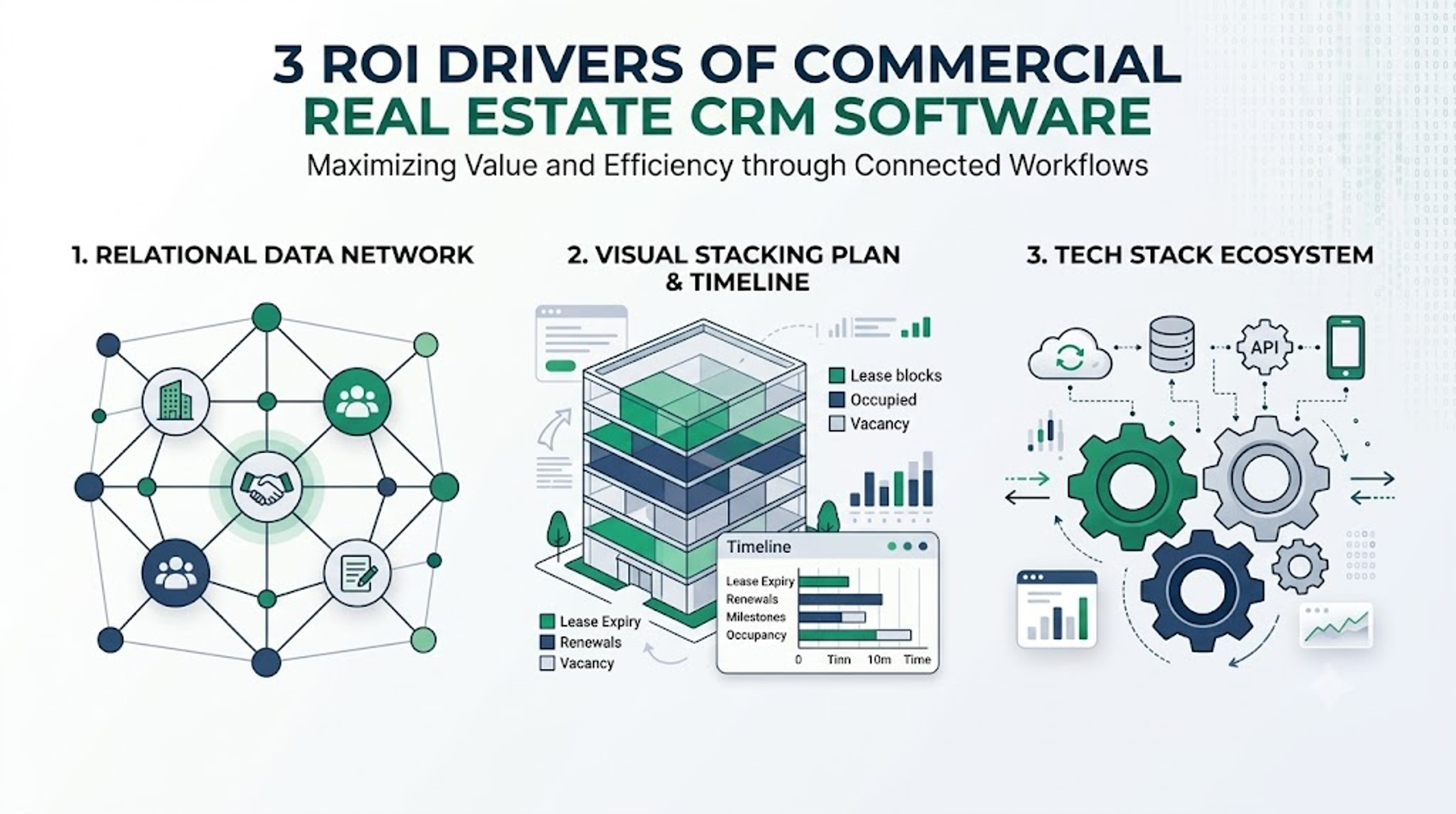
1. Relational Data Architecture
In commercial real estate, data is highly relational. A tenant at one retail center might be a principal investor in an industrial park across town.
Your CRM must dynamically link contacts to properties, properties to leases, and leases to historical comps. If your brokers have to enter the same data in three different modules to update a single record, they will abandon the system by week two. The software must automatically connect the dots, revealing off-market opportunities hidden deep within your existing database.
2. Stacking Plans and Lease Expiration Tracking
Deal velocity depends entirely on timing the market. Visual stacking plans are not a luxury; they are a necessity.
You need automated, algorithmic triggers that alert brokers 12 to 18 months before a major anchor tenant's lease expires. If your CRM relies on manual calendar reminders or sticky notes, you are literally handing commission checks to competing brokerages who leverage automation. The CRM should act as a predictive engine, telling your team who to call and exactly when to call them.
3. Seamless Integration with the CRE Tech Stack
Your CRM must communicate bidirectionally with your marketing engine, your financial models, and your property data platforms.
If your system doesn't sync flawlessly with CoStar, Buildout, Argus, or your email marketing software, you are creating dangerous data silos. Data silos require manual data entry. Manual data entry leads to human error. Human error destroys valuations and compromises high-ticket transactions.
The Best Commercial Real Estate CRMs for 2026
Let’s break down the elite platforms that actually justify their enterprise licensing fees.
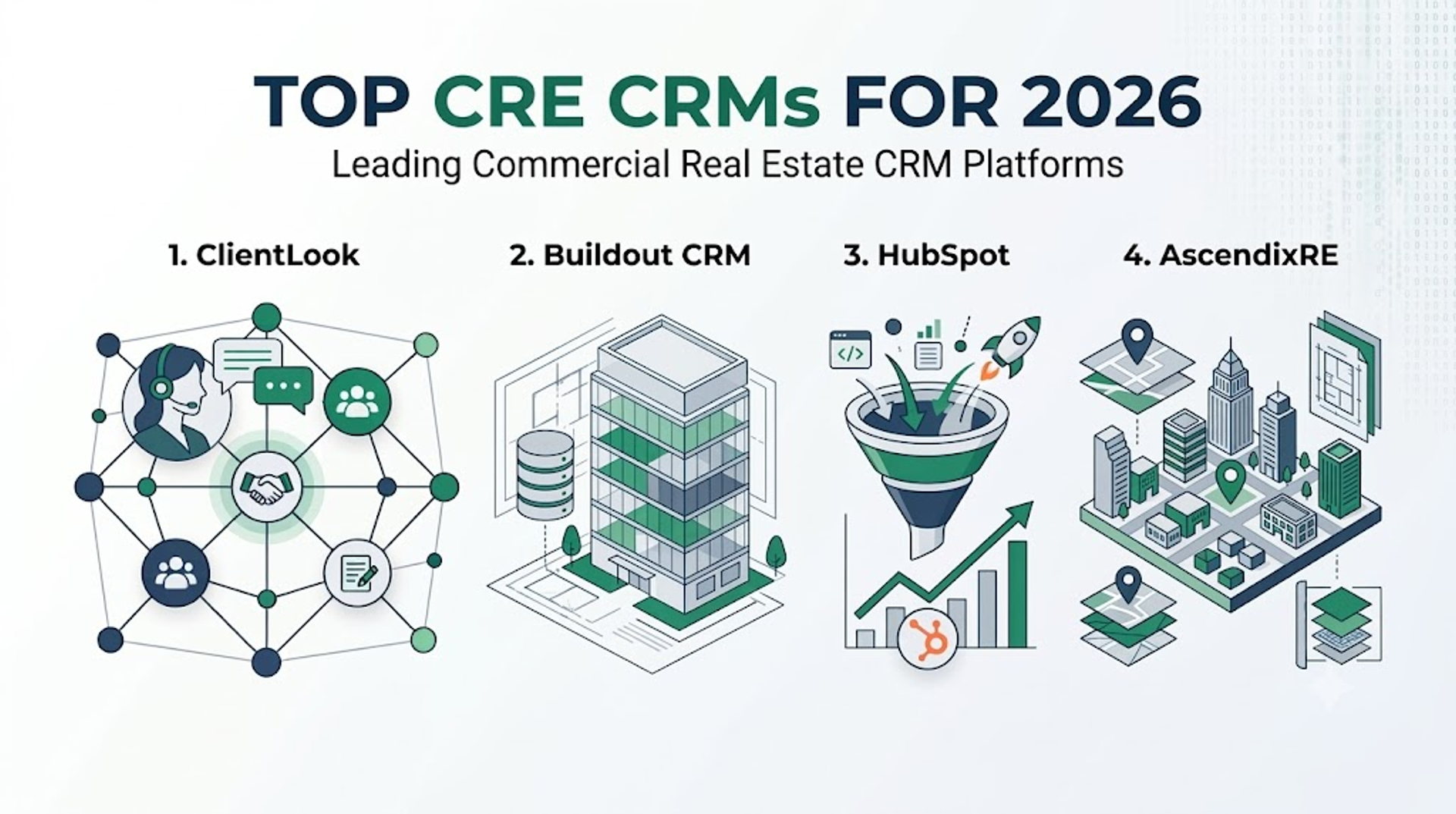
ClientLook: The Pure-Play Brokerage Engine
ClientLook isn't trying to be everything to everyone. It is engineered exclusively for the daily workflow of CRE brokers.
The Strategy: ClientLook acts as a digital personal assistant. It features a unique virtual assistant (VA) service where brokers can simply email their meeting notes, and a human team inputs the data into the CRM on their behalf. The ROI: Near 100% user adoption. Top producers hate data entry more than anything else. ClientLook entirely removes the friction of admin work. The Verdict: Best for tenant rep and investment sales brokers who demand simplicity and refuse to do manual data logging.
Buildout CRM (formerly Rethink): The Salesforce Behemoth
Buildout CRM is built on the robust Salesforce architecture but customized from the ground up specifically for commercial real estate.
The Strategy: You get the enterprise-grade security, scalability, and API ecosystem of Salesforce, without the massive expense of a custom buildout. It understands spaces, properties, and comps natively. The ROI: Infinite scalability and granular data control. You can track highly complex comps, map out property financials, and run institutional-grade pipeline reporting for your board of directors. The Verdict: Best for mid-to-large market firms that need aggressive data modeling, require institutional reporting, and have a dedicated CRM administrator on staff.
HubSpot (With Heavy Customization): The Marketing Powerhouse
HubSpot is a leading marketing automation platform that dominates the inbound marketing landscape.
The Strategy: You choose HubSpot for its powerful marketing automation, not its out-of-the-box CRE features. The ROI: Better marketing alignment. Track which prospects open market reports, click property listings, and revisit your website before making contact. The Verdict: Best for marketing-driven commercial real estate brokerages focused on inbound lead generation. However, customizing its data architecture for CRE properties, leases, and spaces requires significant upfront investment.
AscendixRE: The Enterprise Alternative
AscendixRE is another powerhouse built on top of Salesforce (and now Dynamics 365), offering a highly modular approach to deal management.
The Strategy: Ascendix allows you to strip away the unnecessary noise. You only deploy the specific modules your team actually needs, preventing software bloat. The ROI: It features advanced mapping tools and visual stacking plans directly inside the CRM. Your brokers can visually prospect entire city blocks without leaving the dashboard. The Verdict: Perfect for institutional asset managers, global brokerages, and firms that require heavy visual data representation.
Why Your CRM Implementation Will Probably Fail
Let’s be brutally honest. Software doesn't fix a broken internal process.
If your brokers are currently hoarding data in private spreadsheets out of fear or habit, rolling out a shiny new CRM won't magically create a culture of transparency.
The "Rage-Quit" Phenomenon
Brokers don't abandon CRMs because they are lazy; they abandon them because the User Experience (UX) is garbage.
Consider your website. Google Analytics tells you what happened, but Microsoft Clarity tells you why your users rage-quit your checkout page.
The exact same principle applies to your internal software. If it takes 14 clicks to log a simple phone call, your broker will simply stop logging phone calls. If the interface is cluttered with 50 irrelevant fields, the user's cognitive load spikes, and they exit the system. UX is not a subjective design metric; it is a hard revenue metric. Bad UX kills adoption, which kills data integrity, which kills deals.
The Data Migration Disaster
Migrating 50,000 messy, outdated contacts into a pristine new system is a guaranteed recipe for disaster.
Garbage in, garbage out. You must rigorously audit, clean, deduplicate, and enrich your data before deployment. Do not skip this critical step to save a few thousand dollars. If brokers log into the new system on day one and see duplicate contacts and inaccurate phone numbers, they will immediately lose trust in the platform. Once trust is gone, it never comes back.
How to Force CRM Adoption (Without Firing Your Top Producers)
You cannot politely request CRM adoption. You have to manufacture it through process engineering.
- Tie Compensation Directly to the CRM: This is the most effective strategy in existence. If a deal isn't fully documented in the system, it doesn't exist. No CRM entry, no commission check payout. Watch how fast adoption skyrockets to 100%.
- Mandate Mobile-First Execution: Your top brokers are rarely at their desks. They are on the road, doing property tours, and taking clients to expensive lunches. If the CRM’s mobile application is clunky or lacks core functionality, the system is dead on arrival.
- Automate the Tedious Work: Ruthlessly integrate your inbox and calendar. Automatically log emails and calls. The CRM must be positioned as an elite tool that actively saves time and generates money, not a bureaucratic chore that consumes hours.
The Bottom Line on CRE CRMs
A high-performing CRM transforms your brokerage from a fragmented group of independent contractors into a unified, data-driven machine.
Stop settling for generic software that doesn't understand your business model. Stop tolerating low adoption rates. Demand a system that maps precisely to your deal cycle, accelerates transaction velocity, and fiercely protects your pipeline from competitors.
Is Your Digital Presence Leaking Money?
You just spent 15 minutes obsessing over how to optimize your internal CRM and manage your existing pipeline.
But what about your external pipeline?
Your website is your ultimate CRM feeder. If your site’s UX is broken, confusing, or slow, even the most expensive CRM won't save you because those high-ticket leads will never enter the system in the first place.
Most B2B websites look incredible on the surface but convert like a leaky bucket. You are spending thousands on SEO and paid ads, only to send CEOs to a landing page that confuses them.
Drop your URL below for a Free 5-Minute UX Video Audit.
We don't do fluffy, generic reviews. We use advanced Microsoft Clarity principles to expose exactly where high-net-worth clients are rage-clicking, getting confused, and abandoning your site.
Find out exactly where your website is leaving money on the table. No aggressive sales pitch, just raw, actionable data you can hand directly to your developers.