Launch D2C brands in 90-day
How D2C brands can launch and scale using a 90-day hybrid growth sprint
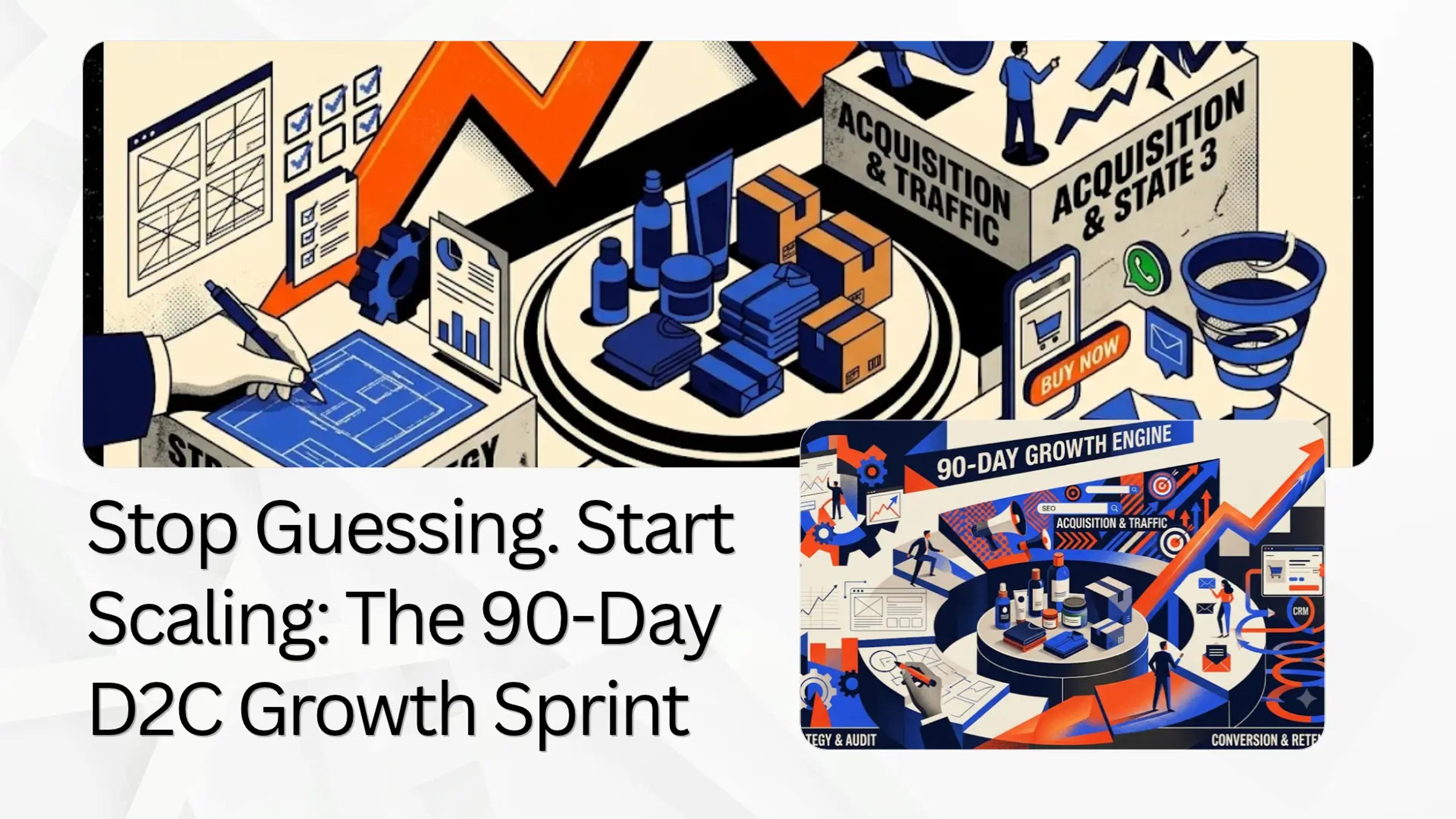
D2C brands in India that want structured momentum rather than guesswork have a faster path to building a revenue engine: the 90-day hybrid growth sprint. Structured across three phases, strategy and audit (days 1–30), acquisition and traffic (days 31–60), and conversion and retention (days 61–90), this sprint gives direct-to-consumer brands a functional customer acquisition engine, an SEO-ready website, and a CRM automation layer that compounds over time. This article walks through every stage of that architecture, as we run it at Offbeat Pixels with early-stage D2C companies across India.
The Indian D2C market has produced genuinely impressive benchmarks. According to Indian Retailer, Snitch reported ₹835 crore in FY26 revenue, and OZiva grew from ₹257.8 crore to ₹463.4 crore in a single year. Those numbers represent the top end of a market where most brands dissolve well before their third year. The gap between those two outcomes is almost never the product. It is the growth infrastructure.
Key takeaways
- Three-phase structure: The sprint divides into strategy and audit, acquisition, and conversion and retention, each with distinct outputs and ownership.
- Conversion baseline: Indian D2C sites typically convert at 1–2.5% overall; the sprint targets the 3–5% top-quartile range, a threshold commonly cited in industry guidance as the benchmark for high-performing D2C ecommerce brands.
- Channel fit varies by category: Fashion brands and wellness brands require different acquisition channel mixes; one-size-fits-all spending is a common and expensive mistake.
- CRM is non-negotiable: Without post-purchase automation, every customer is effectively a first-time buyer every time. According to linkrunner.io, 90-day repeat rates for beauty brands in India range from 28–40%, and the brands at the upper end run structured post-purchase sequences, evidence of how lifecycle automation directly lifts repeat purchase rates and unit economics.
- LTV:CAC is the governing metric: A ratio below 3:1 signals that the brand's acquisition costs are unsustainable.
- Sprint vs. in-house: A sprint-based engagement can deliver comparable growth capabilities with lower fixed overhead than assembling a full in-house team from scratch, a meaningful advantage for many early-stage brands.
Why most D2C brands in India stall before they ever really scale
The customer acquisition trap is the first failure mode. Early-stage brands spend heavily on paid social without a clear CAC-to-LTV model. According to profitbox360.com, the average LTV:CAC across Indian D2C categories is approximately 2.3:1, a ratio that sits uncomfortably close to unprofitable for most business models. Brands that ignore this number acquire customers at a loss and have no mechanism to recoup that spend through repeat purchases.
According to customfit.ai's 2026 benchmarks, fashion sites often sit at the lower end of the 1–2.5% conversion range typical for Indian D2C ecommerce sites overall. Most early-stage websites are built for aesthetics, not buying behaviour. Poor page speed, absent trust signals, surprise shipping fees at checkout, and unclear value propositions all erode conversion before any ad spend can justify itself.
The retention blind spot is what makes both problems permanent. Without CRM automation or a defined post-purchase journey, a brand's customer database is simply a list of people who bought once and were then ignored. High one-time purchase rates are the norm among early-stage direct-to-consumer brands, and that pattern alone destroys unit economics. OZiva's trajectory, noted above, was not built on first purchases alone.
What GTM groundwork does a D2C brand need before the sprint begins?
A go-to-market strategy is only as strong as its customer definition. The ideal customer profile determines which channels are worth spending on, what messaging will land, and which product SKUs to lead with. Brands that skip this step spend their first 90 days optimising for the wrong audience, which is far more expensive than the time it takes to get the definition right.
Channel prioritisation must follow category behaviour, not industry convention. Among DTC brands in India, fashion converts well through Instagram and influencer content; wellness brands like Kapiva, which reported ₹464 crore in FY26, according to Indian Retailer, rely heavily on SEO and educational content because purchase decisions in that category involve genuine research. The pre-sprint work identifies which pattern applies to the brand in question and structures the sprint budget accordingly.
The website must be revenue-ready before traffic is driven to it. A pre-sprint audit should cover load speed, mobile experience, product page structure, checkout friction, payment options including UPI and COD, and trust signals. Sending paid traffic to a site with structural conversion problems is not growth; it is funded experimentation with no return.
How the 90-day hybrid growth sprint is actually structured
| Phase | Days | Primary Focus | Key Activities | Expected Output |
|---|---|---|---|---|
Strategy and Audit | 1–30 | Diagnostic and architecture | Digital audit, competitor SEO gap analysis, ICP definition, brand positioning, website conversion review, and technical fixes | Prioritised action plan and 60-day execution roadmap |
Acquisition and Traffic | 31–60 | Qualified traffic generation | Paid social campaign launch, SEO targeting high-intent keywords, influencer collaborations, and organic pipeline building | Live campaigns with tracked CAC and initial organic visibility |
Conversion and Retention | 61–90 | Revenue per visitor and repeat purchase rate | Landing page testing, checkout optimisation, email and WhatsApp automation sequences, and CRM segmentation | Operational CRM stack with an active post-purchase journey |
Phase 1: diagnostic and architecture (days 1–30)
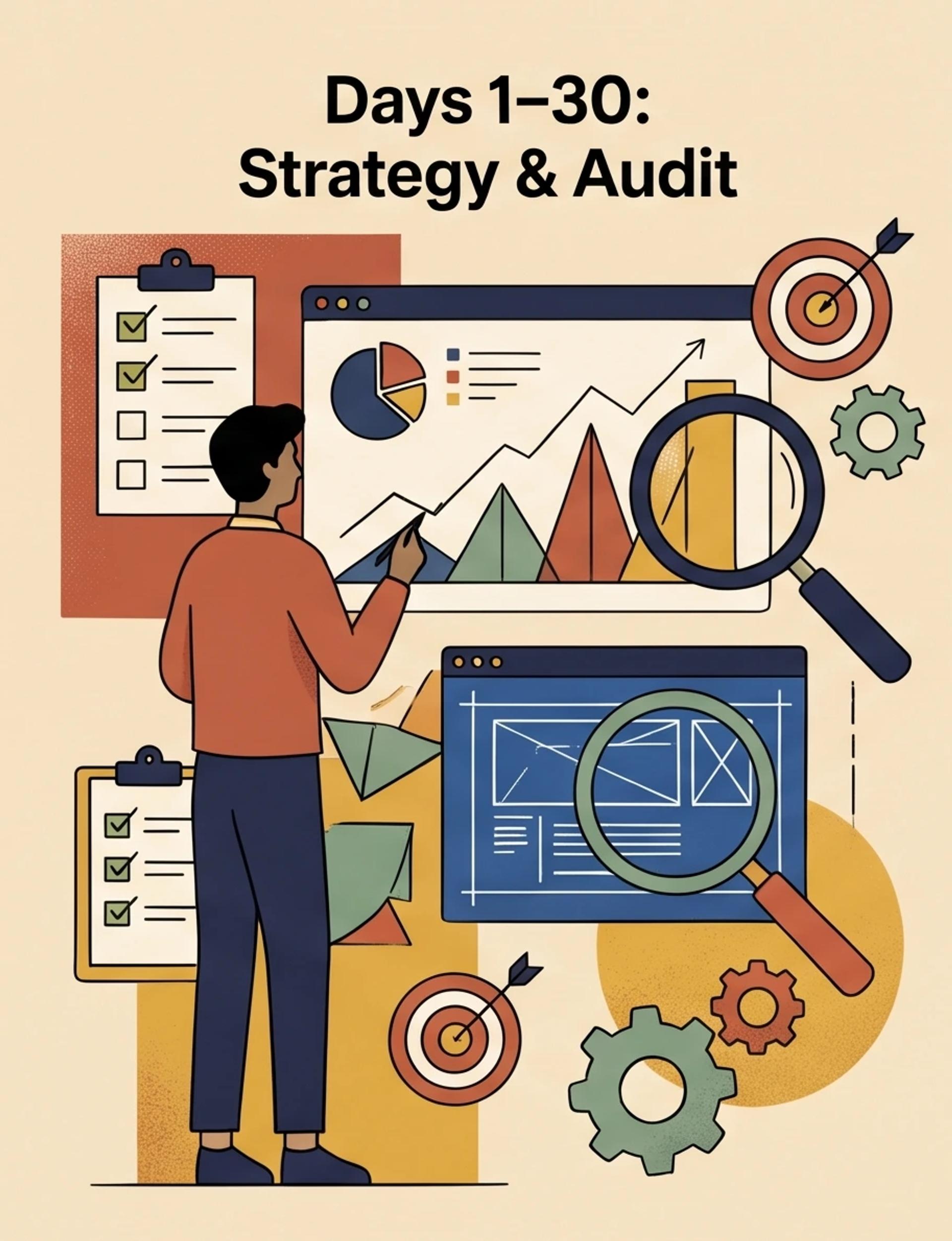
The first phase is diagnostic and architectural. A full digital audit covers the existing website, channel performance, competitor SEO gaps, and brand positioning. Quick-win technical fixes on the site unlock conversion improvements before any significant traffic is driven. This phase is the most unglamorous part of the sprint, and also the most consequential.
Phase 2: paid vs organic acquisition (days 31–60)
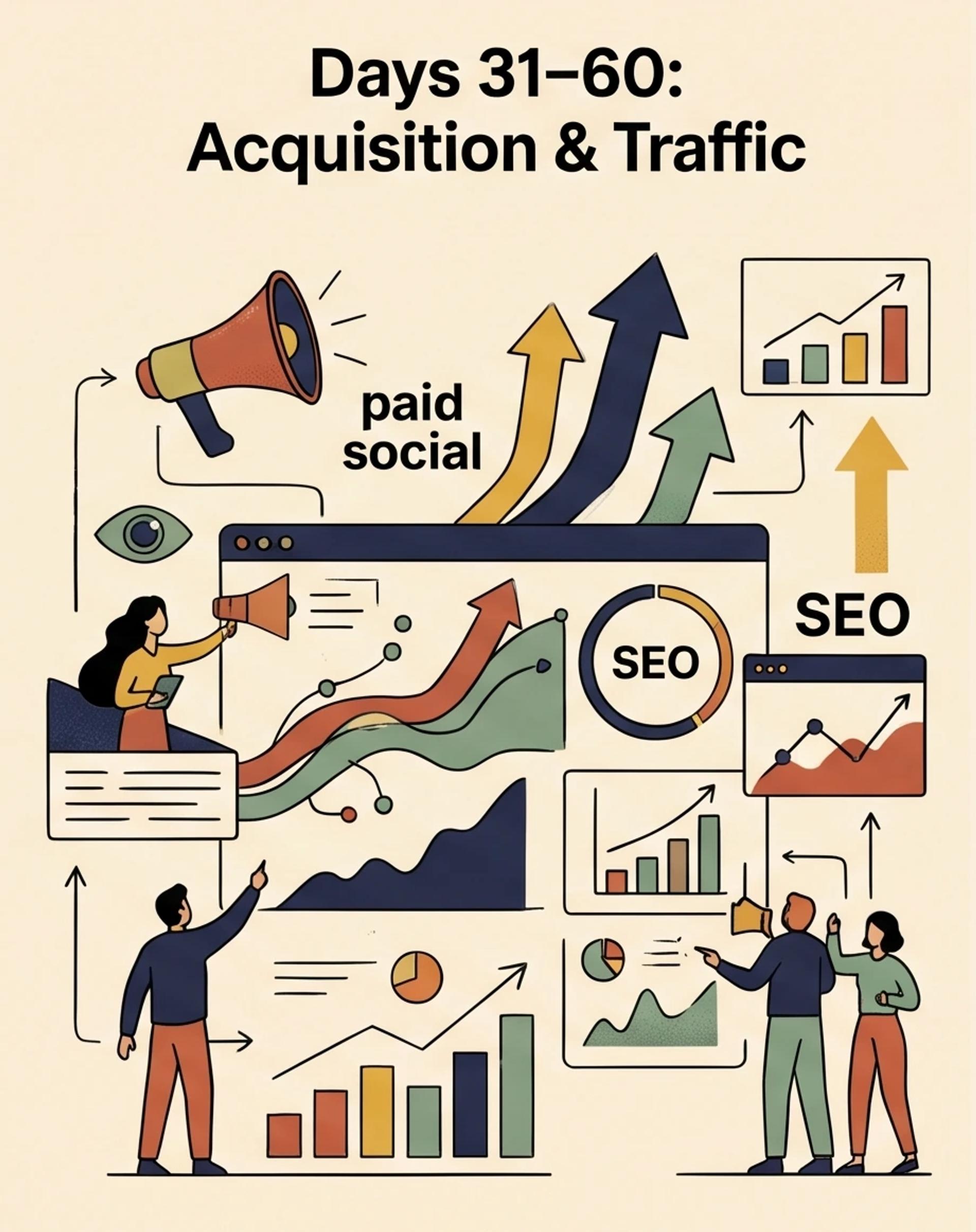
The second phase activates acquisition on the channels identified during the GTM phase, while SEO work begins on high-intent product and category keywords to build an organic pipeline alongside paid spend. The focus is on generating qualified traffic at a defensible cost per acquisition, not raw volume for its own sake. According to modifyed.in, branded search and direct traffic convert significantly better than cold paid social, which makes the organic investment doubly important.
Phase 3: conversion, CRM, and repeat purchase (days 61–90)
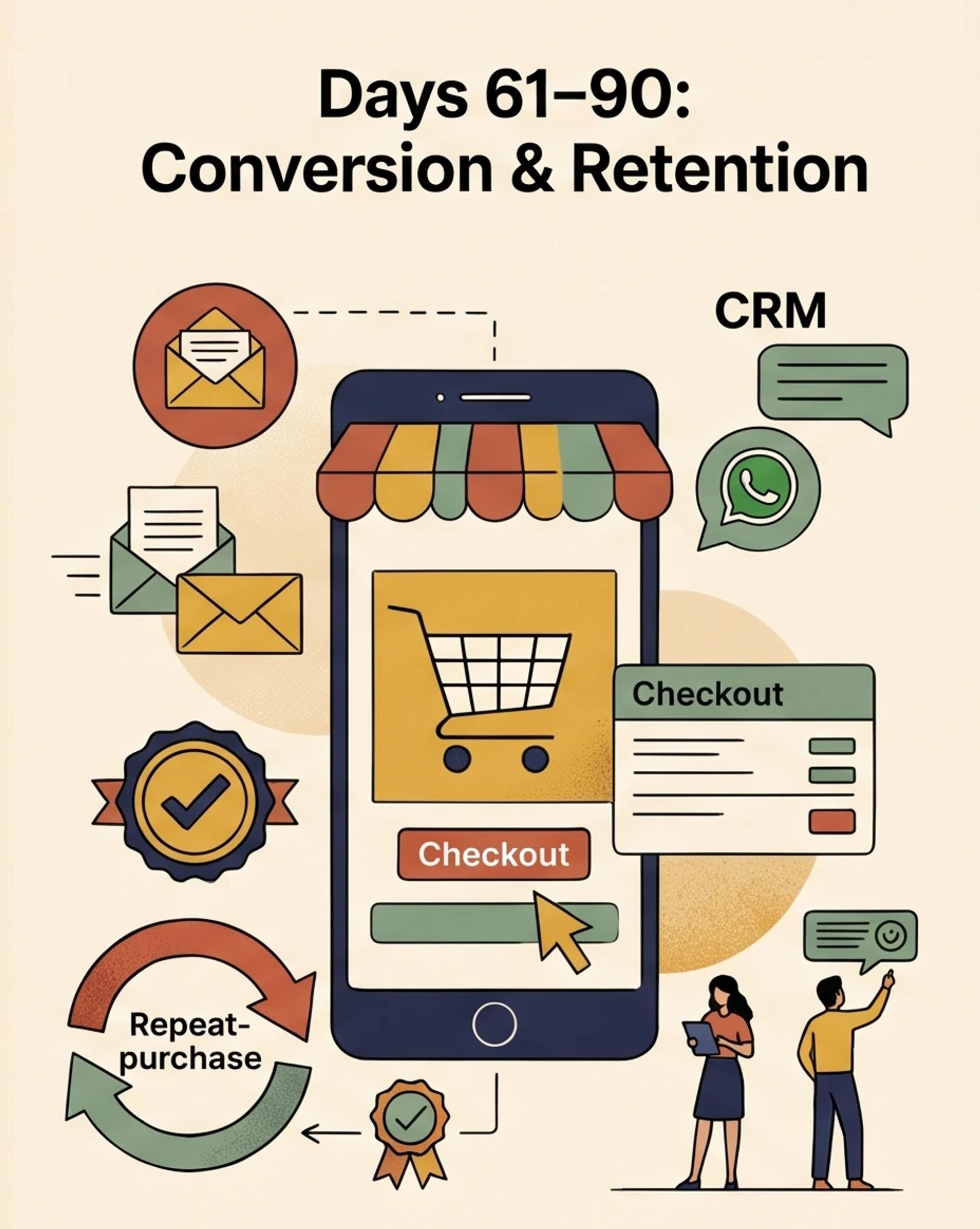
The final phase shifts attention from acquisition to conversion and retention. Landing pages are tested, checkout flows are tightened, and automation sequences are activated for email and WhatsApp. The agency sets up CRM automation and customer journey workflows.
Which acquisition channels drive measurable returns, and how CRM holds the gains
Channel mix is not one-size-fits-all for direct-to-consumer brands in India. Paid social gives immediate traffic but stops the moment the budget does. SEO compounds over time but typically takes several months to generate meaningful organic volume, depending on the category and level of resourcing. A hybrid approach runs both in parallel: paid social to generate revenue now while SEO builds the organic moat. According to distk.in, Meta CAC for Indian D2C brands rose from ₹380 in 2025 to ₹502 in 2026, which makes the case for investing in organic channels even more compelling.
Influencer marketing works when the creator's audience matches the brand's ICP precisely and when the content drives to a high-converting landing page rather than a homepage. Broad-reach campaigns with generic creators generate impressions, not revenue. Category-specific creators with genuinely engaged audiences commonly outperform celebrity partnerships on return on ad spend, a pattern observed particularly in personal care and food categories where product trust is a purchase prerequisite.
Email and WhatsApp are severely underused retention and re-acquisition tools for early-stage D2C startups in India. According to linkrunner.io, 90-day repeat rates for beauty brands in India are approximately 28–40%. The brands at the upper end of that range are not running better ads; they are running better post-purchase sequences. A minimum viable CRM stack includes a welcome series, an abandoned cart sequence, a post-purchase review request, a replenishment reminder for consumable categories, and a win-back flow for lapsed customers.
The metric that governs whether all of this is working is the LTV-to-CAC ratio. According to profitbox360.com, Indian D2C beauty brands achieve LTV:CAC ratios of approximately 3:1 to 6:1, while fashion brands typically land between 2:1 and 5:1. A ratio below 3:1 means the brand is acquiring customers it cannot afford. Tracking this across cohorts reveals which channels produce the most valuable customers, not merely the most customers, and that insight shapes every subsequent sprint decision.
How to run this sprint without building an in-house team
The in-house alternative to a sprint engagement requires hiring a head of growth, an SEO specialist, a CRM manager, and a paid media buyer, all before a single campaign goes live. For a brand at early-stage revenue, that fixed cost is not viable, and the ramp-up time alone can cost an entire quarter of momentum. A sprint-based agency engagement brings a team that has run this playbook across multiple D2C categories, which removes much of that ramp-up risk for brands that cannot afford to lose the time.
At Offbeat Pixels, our 90-day D2C sprint engagement covers the full arc described in this article: GTM strategy, website conversion audit, SEO foundation, paid acquisition, influencer identification, and CRM automation setup. For brands that need continued support beyond the sprint, we also offer retainer and white-label models.
The sprint is aimed at early-stage startups and D2C brands seeking data-driven strategies to acquire customers and improve retention.
The roadmap is clear: start with the audit
D2C brands in India that scale to meaningful revenue do not grow by accident. Reviewing what the top D2C brands in 2026 have in common, the pattern is consistent. The 90-day hybrid growth sprint is a structured path to building those same systems without assembling a full in-house team.
The playbook is sequential by design. Start with the audit. Prioritise ruthlessly. Build acquisition on a foundation that can actually convert the traffic it receives. Then activate retention before acquisition cost outpaces customer lifetime value. Each phase builds on the one before it, and skipping any one of them is what sends most early-stage brands back to square one. If your brand is ready to run that sequence with a team that has done it before, get in touch with us at Offbeat Pixels to discuss what the first 30 days would look like.