Ads Aren't the Only Growth Lever
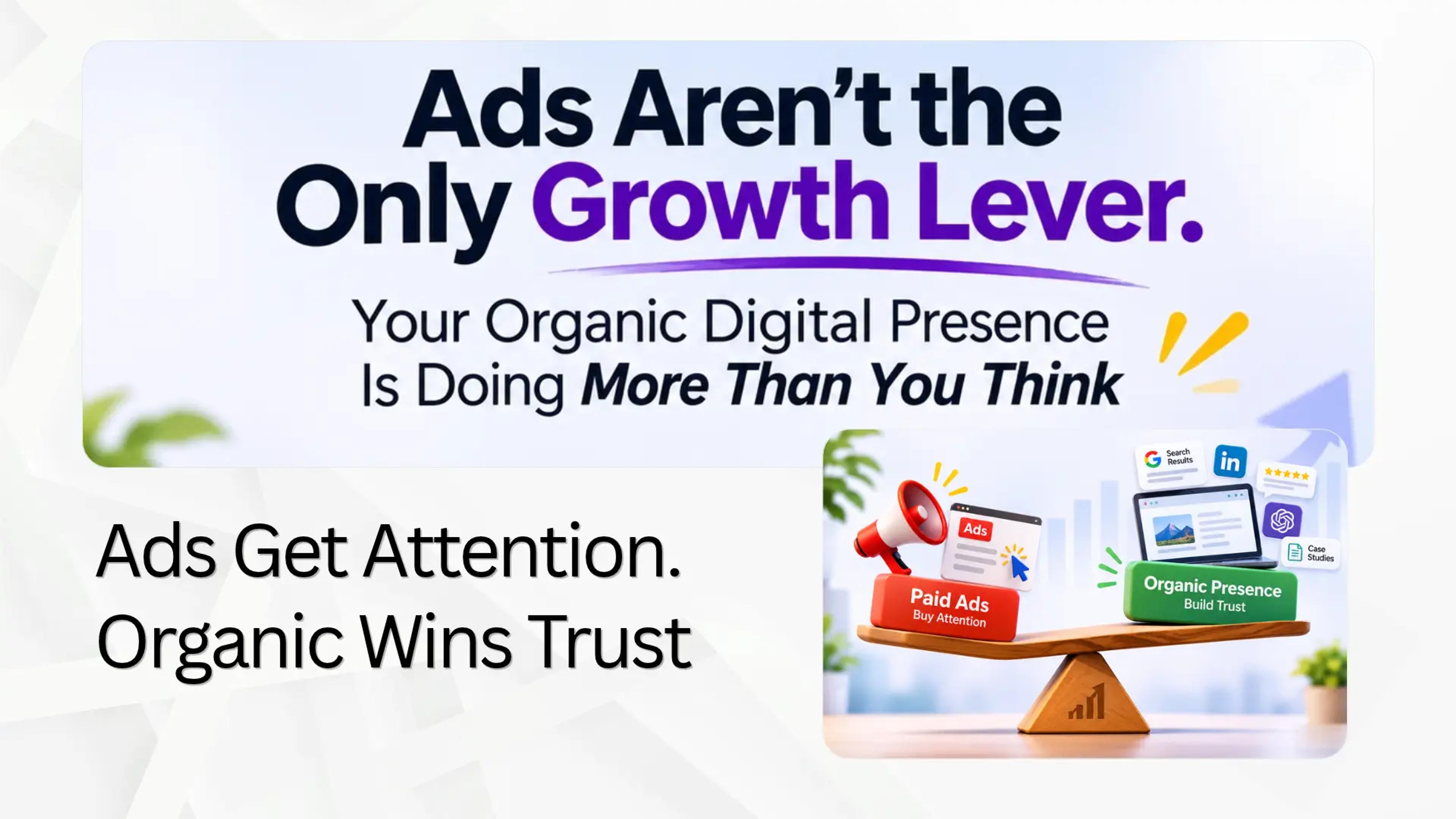
Ads Aren't the Only Growth Lever. Your Organic Digital Presence Is Doing More Than You Think
Most businesses still think about growth in terms ofpaid acquisition.
Want more leads? Increase the ad budget. Want more traffic? Run another campaign. Want faster results? Spend more.
And honestly, that approach can work.
But there’s a problem: your ads can get someone to notice you, but they can’t do all the convincing for you.
Before contacting a business, people increasingly check its website, LinkedIn, reviews, case studies, content and even AI search results. They want to know whether the business actually understands what it claims to do.
Key Takeaways:
- Ad spend buys attention only while you're paying for it. Organic content is what builds trust before a prospect ever talks to you.
- AI tools like ChatGPT, Perplexity, and Google AI Overviews now answer buying questions directly, and they cite sources, not ad campaigns.
- If your website, LinkedIn, Google Business profile, and content don't say the same thing, both prospects and AI engines lose confidence in recommending you.
- Fixing this means writing organic content that directly answers real buyer questions, consistently, everywhere your business shows up.
Ads Buy Attention. They Don't Buy Trust.
Ads get you visibility right now, for exactly as long as you keep paying. The moment the budget pauses, so does the reach.
What ads don't buy you is the thing that shows up when nobody is actively looking, when someone asks a question and expects a real answer, not a sponsored slot.
That's where organic presence comes in. And it's changing shape faster than most content calendars are catching up to.
Organic Marketing Was Never Just SEO. It Was Always Proof.
A website. A set of case studies. A LinkedIn presence. A body of content.
None of it was ever really about search rankings. It was proof that a business understands the problem it claims to solve.
A prospect reading your content before a call isn't hunting for keywords. They're checking:
- Do you actually get their industry?
- Do you understand their stage of growth?
- Have you solved this exact problem before?
Ads get you the click. Organic content is what earns the trust before the conversation even starts.
Organic is the credibility layer. Skip it, and every ad dollar has to work twice as hard to convince someone who has no other reason to believe you.
AI Search Is Changing How Clients Find You
The way people find businesses is shifting.
It's not just Google anymore. People are asking ChatGPT, Perplexity, Gemini, and Google's own AI overviews questions like:
- “Who's a good CRM consultant for a mid-size sales team?”
- “How do I choose agrowth marketing agency?”
These engines don't show ten blue links. They synthesize one answer, often naming specific companies, and they pull that answer from content that's already structured in a way a model can read, understand, and trust enough to cite.
If your organic content isn't built for that, if it's thin, generic, or just says “we help businesses grow” without ever answering the real question, you don't rank lower.
You disappear from the answer entirely.
Ads can't buy you a spot inside someone else's AI-generated recommendation. Only content that's genuinely useful and specific enough to be understood can, this is the core idea behind generative engine optimization, or GEO: writing so the answer to a real question sits clearly on the page, not buried in marketing language.
Consistency Build Trust
Here's the part most businesses get wrong even after they've accepted that organic matters: they treat every platform separate.
- The website says one thing
- The LinkedIn about section says something slightly different
- Google Business has an outdated description
- The published content doesn't clearly connect to any of it
A prospect who touches three of those platforms before booking a call notices the mismatch, even subconsciously. It reads as unclear, or unfinished. Trust drops a little every time the story doesn't line up.
Now stack the AI layer on top of that.
Generative engines don't take one source at face value, they cross-check. If a model is deciding whether to recommend you, it's effectively comparing your website against your LinkedIn, against your content, against what other sources say about you.
Consistency across all of it isn't a branding nicety anymore. It's a confidence signal in how these systems decide who to name and who to leave out.
Same core message, everywhere:
- Who you help
- What you actually do
- What makes you different
Every platform can have its own voice, but the core message should stay the same. That’s what turns content from simply being active into something that builds value over time.
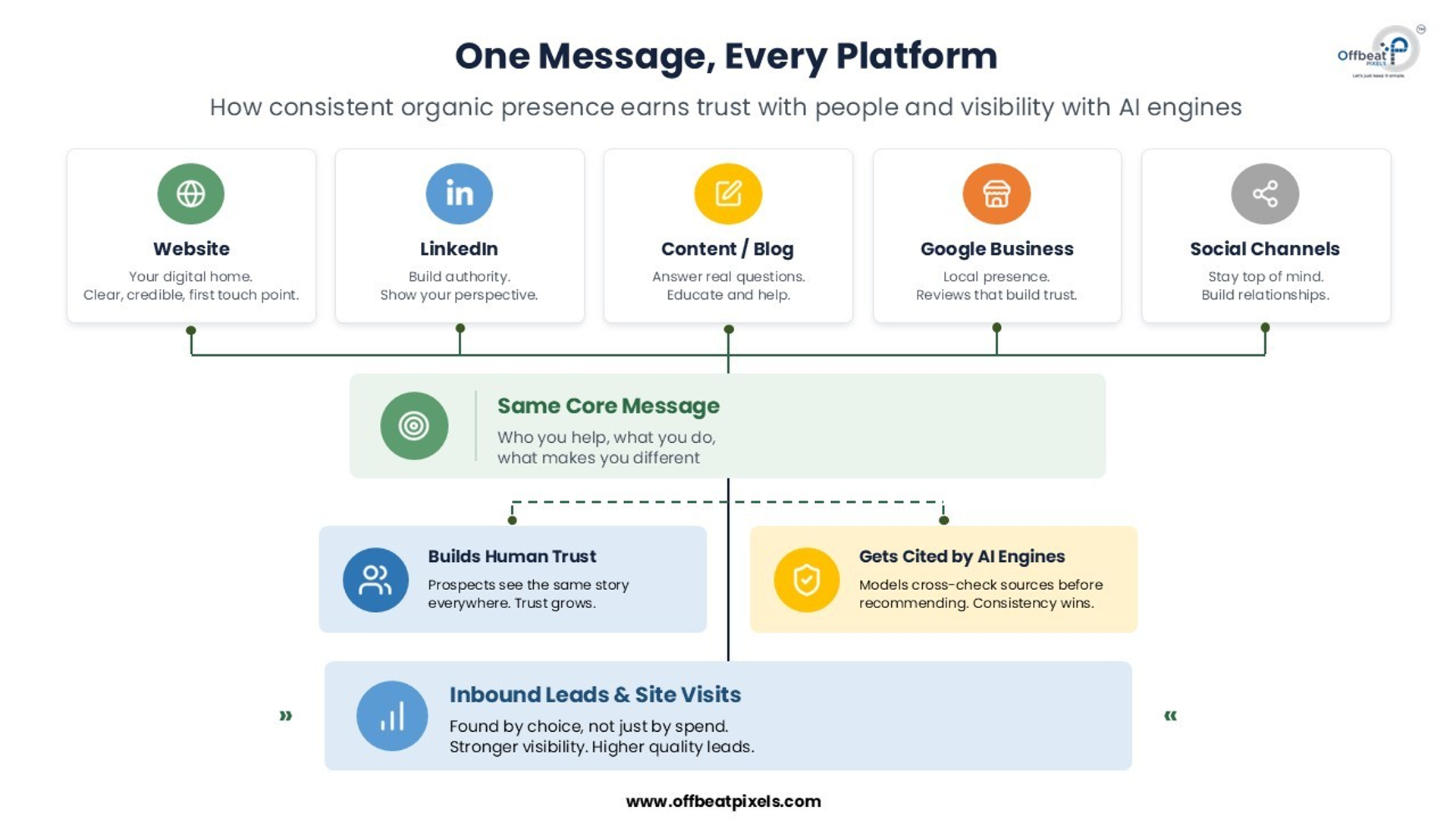
One Message, Every Platform
What This Actually Means in Practice
It doesn’t mean you stop running ads.Paid campaigns remain one of the fastest ways to create immediate visibility and demand.
But treating organic content and ads as two separate budgets, one for now and one to ignore, is a mistake that's about to get more expensive.
Organic content that addresses the concerns being faced by your audience base in the language that they would understand increases your probability of getting discovered by leaps and bounds. The benefits of a strong organic presence are two-fold:-
- It builds trust with the human reading it
- It becomes the raw material generative engines use to decide who to recommend
The businesses getting this right early aren't necessarily the ones with the biggest ad budgets. They're the ones whose message is specific, honest, and consistent enough that both a human and a model walk away thinking:
“these people actually know what they're talking about.
Try This - The Lead Intent Test
Audit the leads generated over the last 6 months and identify how many were already in the Evaluation/Intent stage of the funnel at the time of their first interaction with your business.
If less than 20% of your total leads were in the Evaluation/Intent stage, it’s a clear indication that you need to strengthen your organic marketing efforts to attract more qualified, high-intent prospects.