The Next Big Shift in Digital Advertising Is Happening Inside AI Conversations
ChatGPT Ads Are Here. But Why Are Brands Interested?
ChatGPT Ads achieved a $1 billion annualised revenue run rate in less than 200 days. That’s an impressive headline. But here’s the interesting part: early reports suggest click-through rates have been considerably lower than those seen on Google Search. So why are advertisers interested in paying for space inside AI conversations?
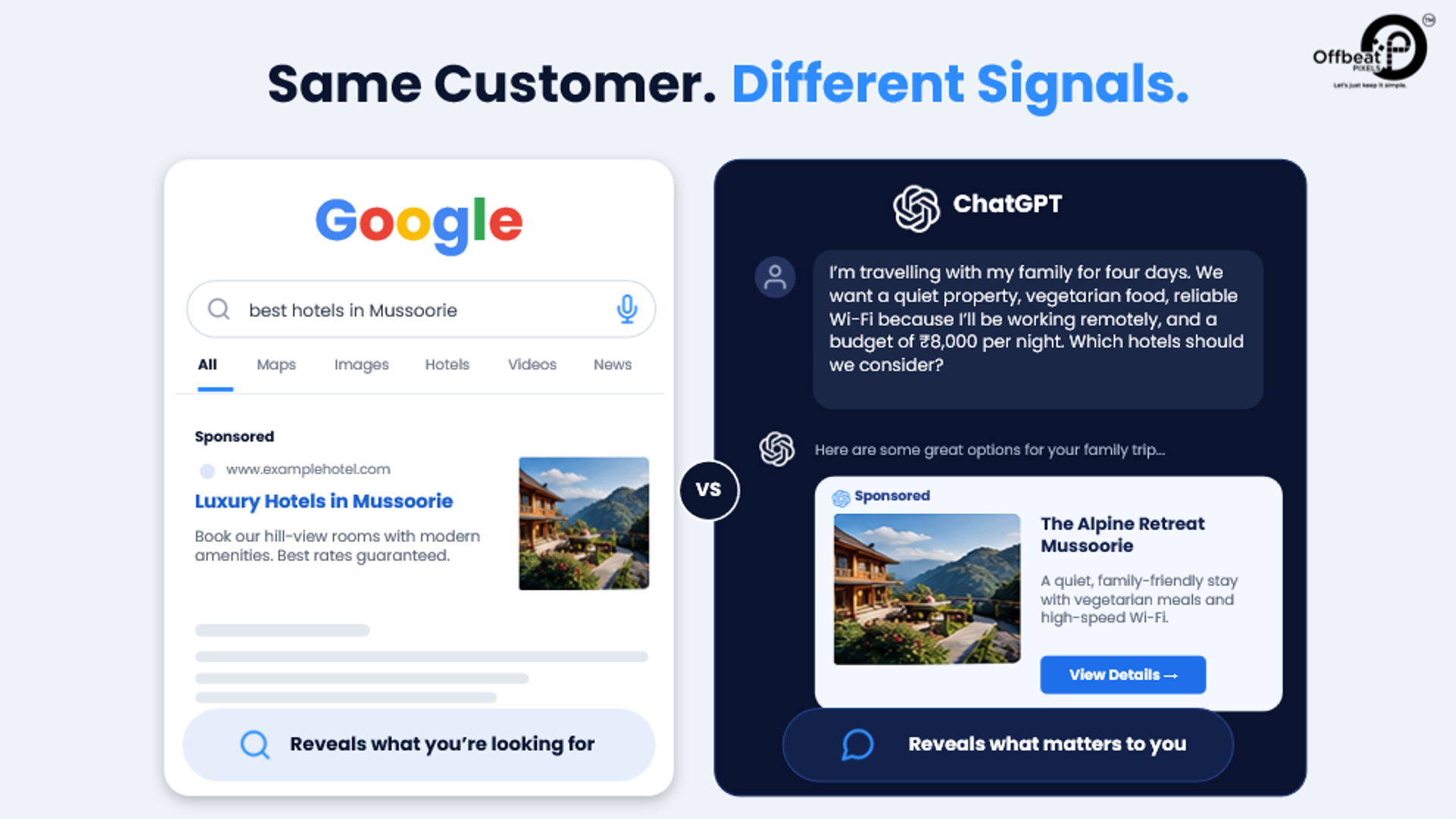
Imagine you’re planning a family holiday in Mussoorie. On Google, you might search: “Best hotels in Mussoorie.” But on ChatGPT, you might ask: “I’m travelling with my family for four days. We want a quiet property, vegetarian food, reliable Wi-Fi because I’ll be working remotely, and a budget of ₹8,000 per night. Which hotels should we consider?”
Both searches aim to find a hotel, but they differ in the level of detail they provide. The Google search tells us what you’re looking for. The ChatGPT conversation explains what matters to you, what you’re willing to spend, and what might influence your decision. That’s the opportunity advertisers are beginning to explore.
Same customer, different signals. Google captures searches; ChatGPT understands preferences and decision-making context.
First, What Exactly Are ChatGPT Ads?
ChatGPT Ads are sponsored placements that appear separately from the AI’s responses. Rather than relying exclusively on traditional search keywords, conversational advertising can use the context of a request to identify relevant opportunities. Someone researching hotels might encounter an advertisement for a property; someone comparing CRM software might see a sponsored software offering.
OpenAI says these advertisements are clearly labelled and do not influence the answers ChatGPT generates. It also states that advertisers do not receive access to users’ private conversations. A paid advertisement inside ChatGPT is not the same as an organic recommendation from ChatGPT. One is purchased visibility; the other is part of an AI-generated response.
Why Is OpenAI Introducing Advertising?
Running an AI platform is expensive. Every conversation requires computing resources, and not every user pays for a subscription. OpenAI has positioned advertising as one way to support access for users on free and lower-cost plans.
There is also a commercial opportunity. People use AI tools to research purchases, compare options, understand products and evaluate services—activities that have traditionally generated enormous advertising revenue for digital platforms. Advertising creates a way to monetise some of that activity without relying entirely on subscriptions. But advertisers will ultimately judge the channel by the business results it delivers, not the number of people using ChatGPT.
Google, Meta and ChatGPT: Three Different Advertising Opportunities
Google Ads: Reaching People Who Are Already Searching
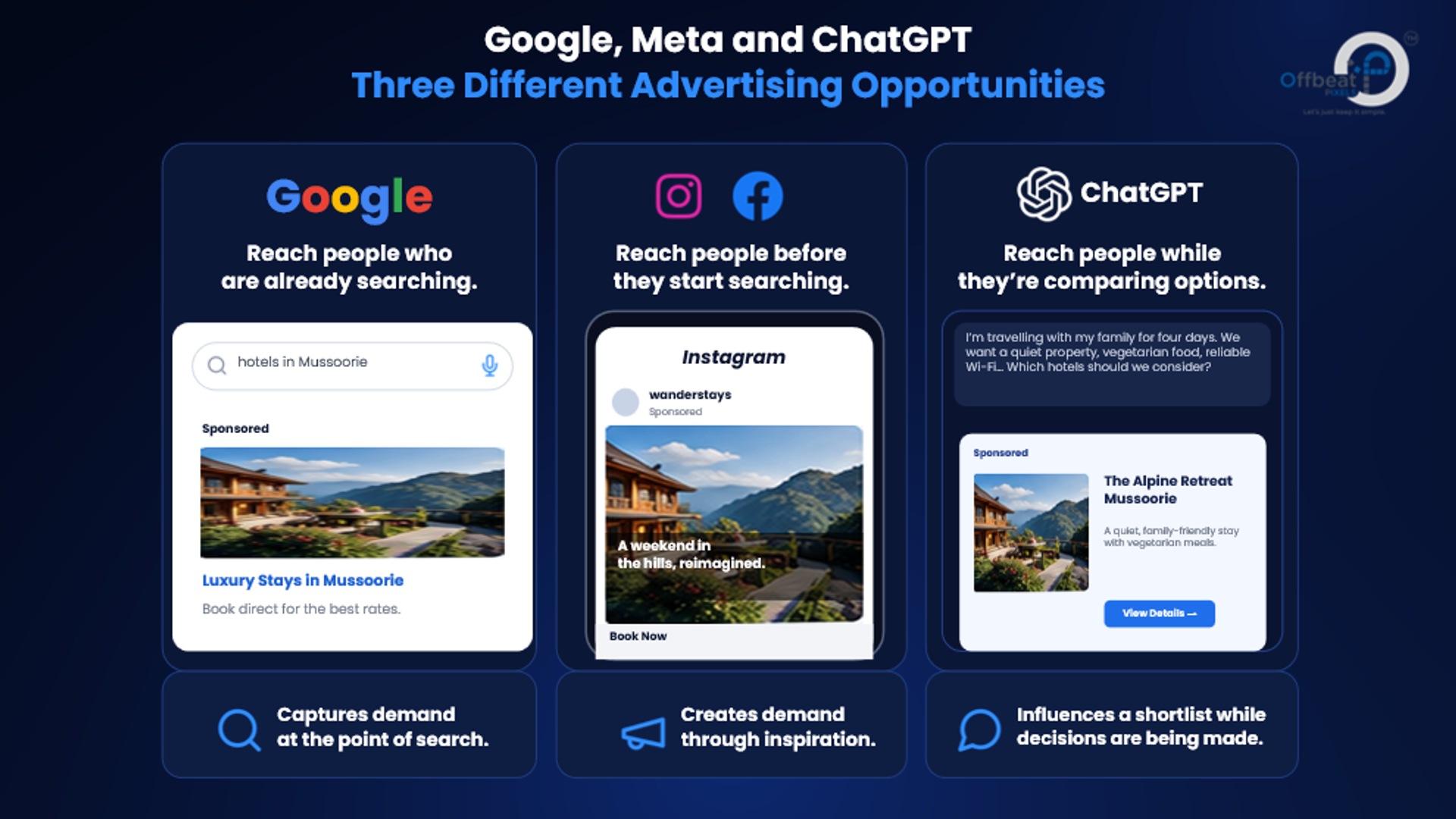
Someone searches for “luxury hotels in Mussoorie.” Google can show advertisements from hotels competing for that search. The person has already expressed an interest in accommodation, and the advertiser can appear when that interest is visible.
Meta Ads: Reaching People Before They Start Searching
The same person is scrolling through Instagram and sees a beautiful reel showing a mountain resort. They weren’t actively searching for a hotel, but the ad may inspire a trip. Meta can introduce a product or experience before someone has decided to look for it.
ChatGPT Ads: Reaching People While They’re Comparing Options
Now that person asks ChatGPT to compare properties based on budget, location, food preferences and family requirements. The conversation is about deciding which hotel fits. A relevant sponsored placement can reach the customer during that evaluation.
Google helps brands appear when people search. Meta helps brands attract attention while people browse. ChatGPT creates an opportunity to reach people while they discuss and evaluate decisions. These categories overlap, of course: Google and Meta also support research and conversion. Conversational AI adds another environment in which customers can discover and evaluate businesses.
Google captures demand, Meta creates interest, and ChatGPT reaches customers while they compare options.
But Does More Context Mean Better Advertising Results?
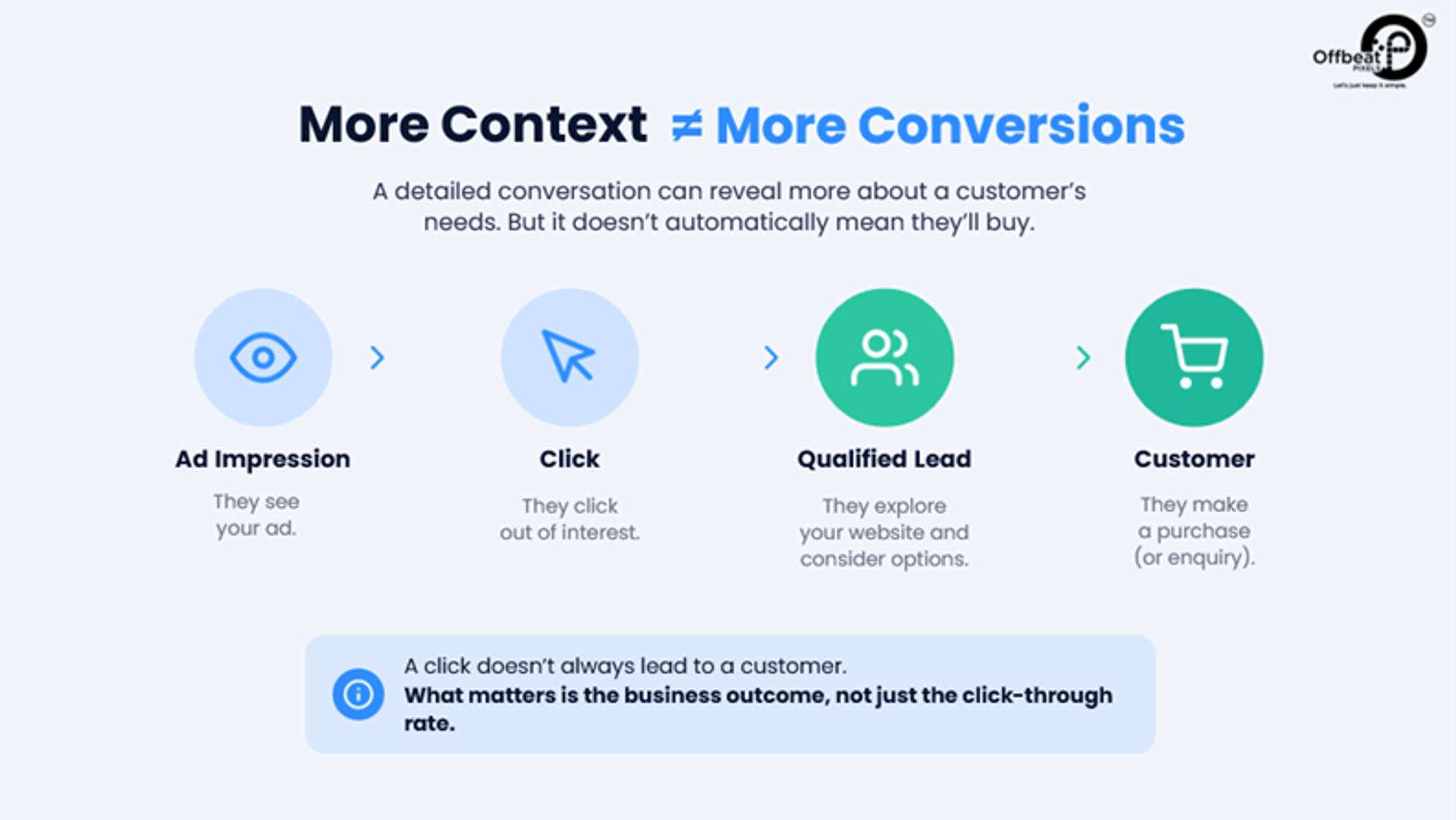
Not necessarily. A detailed conversation may reveal more preferences than a short keyword search, but that does not automatically make someone more likely to purchase. One person comparing hotels might be ready to book; another might be daydreaming about a future trip.
Early industry reports have shown mixed performance, including click-through rates below some established search benchmarks. But click-through rate alone cannot tell the whole story. A person may remember an ad and return later, or click out of curiosity and never buy.
The meaningful questions are whether ads reach relevant prospects, generate qualified leads, produce measurable purchases, and create incremental business. Until more independent data becomes available, it is too early to say whether conversational advertising will outperform established channels. Better targeting context is an opportunity; better business outcomes still need to be proven.
More context doesn't guarantee conversions. What matters is turning ad clicks into actual customers.
The Biggest Challenge Isn’t Advertising Technology. It’s Trust.
People ask ChatGPT questions, compare alternatives and sometimes share budgets or uncertainties they might not tell a salesperson. They expect assistance, not necessarily a sales message. Ads introduce a delicate balance: relevant, clearly separated placements might help users discover options; intrusive or confusing placements could undermine confidence.
OpenAI says its advertising systems are separate from answer generation. But users still need to understand when they are receiving an AI-generated response and when they are seeing paid promotion. An advertisement can earn attention. It cannot automatically earn trust.
What Does This Mean for SEO, GEO and AEO?
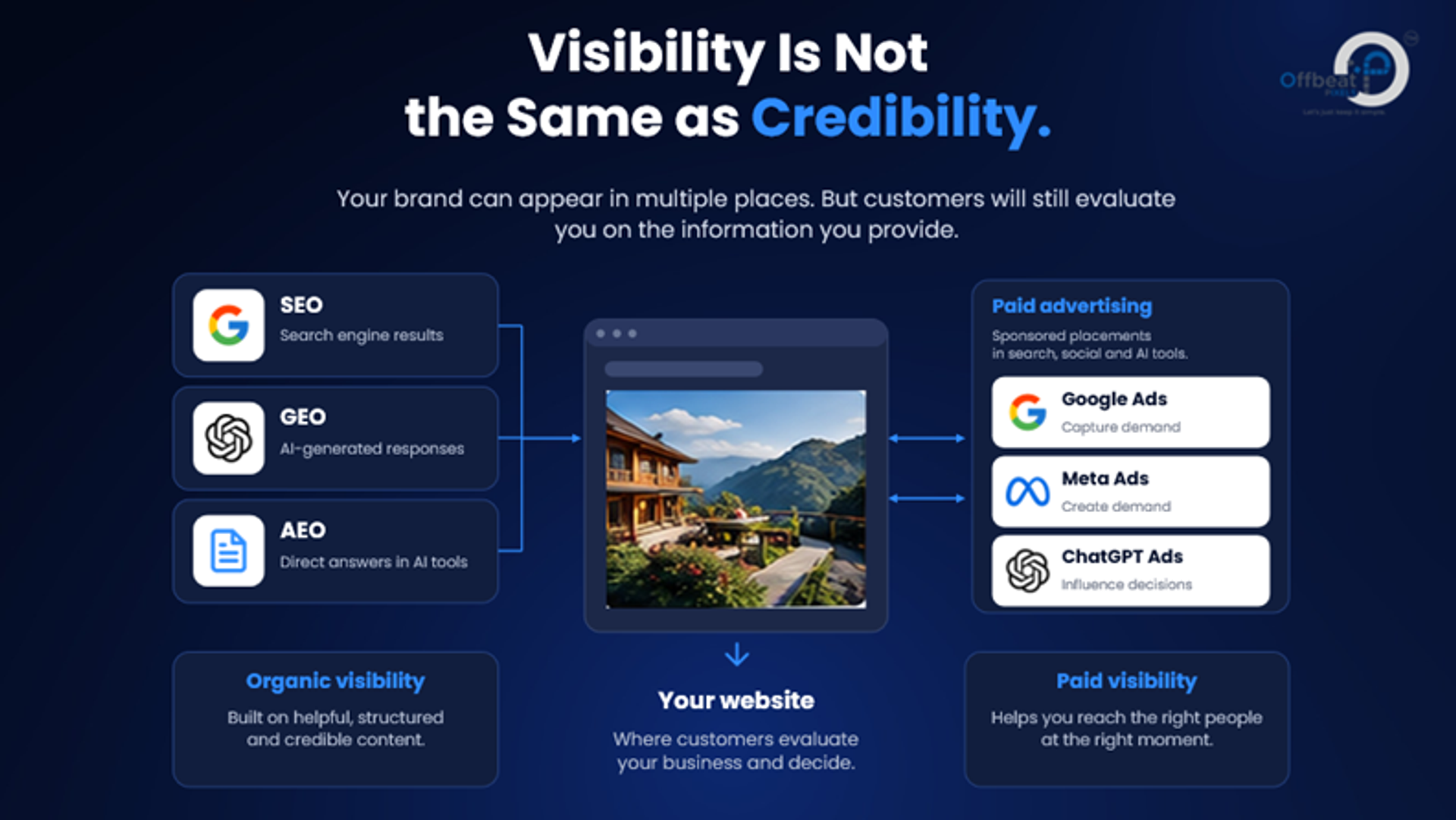
Advertising in AI tools is only one way to gain visibility. SEO helps websites appear in search results. Answer Engine Optimisation (AEO) makes information clear and useful for systems providing direct answers. Generative Engine Optimisation (GEO) seeks to improve how accurately brands are represented in AI-generated responses. These practices overlap; none guarantees an AI mention.
Paid conversational advertising purchases a labelled placement. But if a hotel’s website fails to explain amenities, pricing, policies or location, visitors may still struggle to choose it. The same applies to software, consulting and other services. Businesses need clear product descriptions, accurate details, genuine reviews and case studies, helpful answers, structured pages and transparent differentiation.
The goal shouldn’t be to appear everywhere. It should be to give customers enough credible information to choose you.
Visibility gets you noticed. Credibility helps customers choose you.
Should Businesses Start Advertising on ChatGPT?
For most businesses, the answer is not to abandon existing channels. Google Search has established intent and mature measurement; Meta has strong discovery and creative capabilities. ChatGPT advertising is still evolving. Test when the economics make sense.
1. Start With a Specific Customer Situation
Ask what questions prospective customers would pose to AI before choosing a business like yours. A hotel might focus on family accommodation; a cybersecurity provider on comparing security solutions. Understanding the situation matters more than chasing the format.
2. Make Sure Your Website Can Convert Interest Into Business
Check whether visitors can understand your offering, see proof of experience, identify the next step and complete an enquiry or booking. More traffic will not fix unclear positioning or a confusing journey.
3. Measure Business Outcomes, Not Just Clicks
Track qualified enquiries, acquisition costs, conversion rates and revenue where attribution is reliable. A controlled test is more sensible than shifting large budgets away from proven channels.
Will AI Advertising Replace Google and Meta Ads?
There is no convincing evidence it will in the foreseeable future. People will still search, discover brands through social content and increasingly compare options through AI. One customer might discover a hotel on Instagram, research it on Google, compare it in ChatGPT and book on the hotel’s website. Which channel deserves credit? That attribution challenge may become more complicated.
Rather than viewing AI advertising as a replacement, businesses should consider it another possible part of the customer journey.
The Real Shift Is Bigger Than ChatGPT Ads
For years, digital advertising has focused on reaching the right audience with the right message at the right time. Conversational AI adds another dimension: customers can explain their needs, concerns and priorities in natural language while researching a decision.
That creates opportunities for relevance, but also questions about privacy, trust, measurement and commercial messages alongside AI assistance. Platforms will experiment, advertisers will test, and evidence will show where this channel adds value.
Don’t build your marketing strategy around every new ad placement. Build it around understanding customers, explaining your value clearly and giving people credible reasons to choose you.
Because whether someone finds your brand through Google, Instagram or an AI conversation, the final question remains the same: Can your business deliver what that customer is actually looking for?